
The Power of Social Media Marketing: How Brands Can Grow in a Connected World
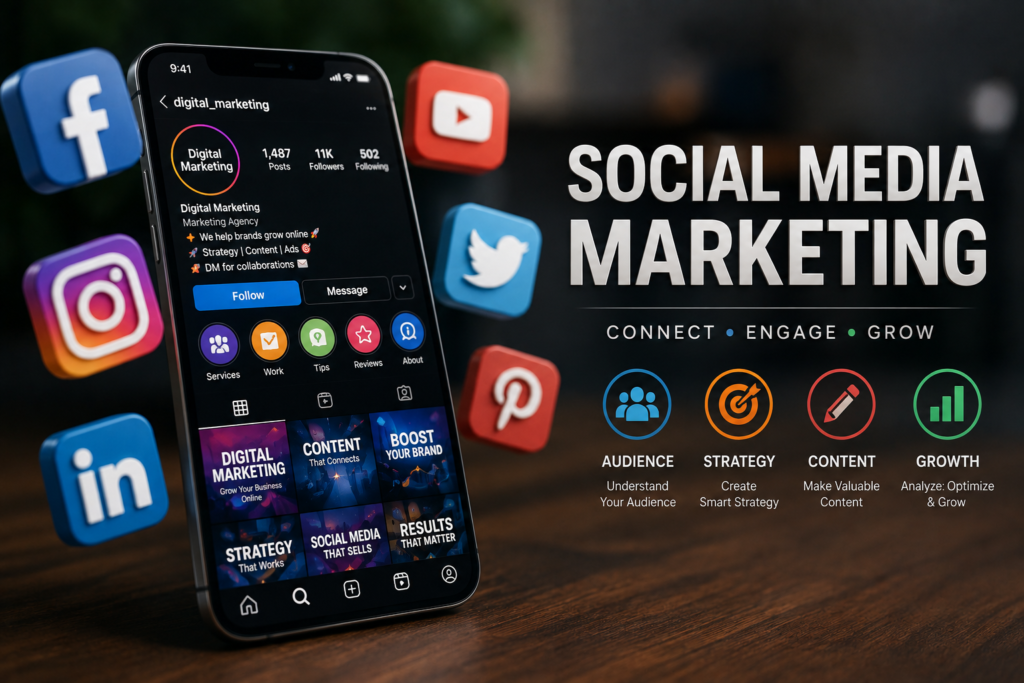
Social media has transformed the way people communicate, discover information, and make purchasing decisions. What started as a simple way for people to connect with friends and share their lives has evolved into one of the most powerful marketing channels in the world.
Today, businesses of every size use social media to build awareness, communicate with customers, showcase their products, generate leads, and create long-term relationships with their audiences.
However, successful social media marketing is not simply about posting regularly. It is about understanding people, creating meaningful content, building trust, and using data to make smarter decisions.
What Is Social Media Marketing?
Social media marketing is the process of using social networking platforms to promote a brand, product, service, or personal identity.
It can involve both organic and paid strategies.
Organic marketing focuses on building an audience naturally through content, conversations, community engagement, and consistent activity.
Paid social media marketing involves advertising to targeted audiences in order to achieve specific objectives such as website visits, leads, sales, or brand awareness.
The most successful strategies often combine both approaches.
Why Social Media Is Important for Modern Businesses
One of the biggest advantages of social media is the ability to communicate directly with potential customers.
Traditional advertising often follows a one-way communication model. A business creates an advertisement and sends it to an audience.
Social media is different.
People can comment, share, ask questions, send messages, provide feedback, and interact directly with brands.
This creates an opportunity for businesses to build relationships rather than simply display advertisements.
Social media can help businesses:
- Increase brand awareness
- Reach new audiences
- Generate website traffic
- Build customer relationships
- Generate leads
- Promote products and services
- Improve brand credibility
- Understand customer opinions
- Build online communities
For small businesses especially, social media can provide an affordable way to compete with larger brands.
Choosing the Right Social Media Platform
One common mistake businesses make is trying to be active on every social media platform.
Being everywhere is not necessarily the best strategy.
Different platforms attract different audiences and support different types of content.
For example, visual content can work particularly well on image- and video-focused platforms. Professional content may be more suitable for business-oriented networks, while long-form and short-form video can be powerful for educational and entertainment content.
The right platform depends on:
Who is your audience?
What type of content do they consume?
What are your marketing goals?
What type of content can your business consistently create?
A business should focus its energy on the platforms that provide the greatest opportunity to connect with its target audience.
Content Is the Heart of Social Media Marketing
Without good content, social media marketing becomes difficult.
People follow accounts because they expect something valuable in return.
That value can come in many forms.
It can be educational.
It can be entertaining.
It can be inspirational.
It can be informative.
It can solve a problem.
It can tell a story.
A strong social media strategy usually includes a combination of different content formats.
Educational Content
Educational content helps audiences learn something useful.
For a digital marketing professional, this could include:
- SEO tips
- Social media strategies
- Website optimization ideas
- Marketing mistakes
- Content creation tips
- Advertising advice
Educational content can help position a brand as knowledgeable and trustworthy.
Entertainment Content
Not every post needs to teach something.
Entertainment can help brands attract attention and increase engagement.
Humor, creative videos, interesting stories, trends, and relatable content can make a brand feel more human.
Promotional Content
Businesses also need to promote their products and services.
However, constantly asking people to buy something can make social media feel like a continuous advertisement.
A better approach is to balance promotional content with educational, entertaining, and valuable content.
The Importance of Storytelling
People remember stories better than advertisements.
A business can simply say:
“We provide digital marketing services.”
Or it can tell a story about how a business struggled to attract customers online, what strategy was implemented, and how the digital presence improved.
The second approach creates context.
Storytelling can make a brand more relatable and memorable.
For personal brands, storytelling is particularly powerful.
Sharing your learning journey, challenges, projects, mistakes, and achievements can help people understand the person behind the brand.
Short-Form Video Is Changing Content
Short-form video has become a major part of social media marketing.
People consume short videos because they are quick, visual, and easy to understand.
A business can use short videos to:
- Explain a product
- Share quick tips
- Answer frequently asked questions
- Show behind-the-scenes content
- Present customer experiences
- Share industry insights
- Demonstrate a service
But successful video content is not only about having expensive equipment.
A clear idea, strong opening, useful information, and good presentation can often be more important than expensive production.
The goal should be to capture attention quickly and provide value.
Building a Community Instead of Just an Audience
An audience watches.
A community participates.
This difference is extremely important.
A brand with thousands of followers may have less influence than a smaller brand with an active and engaged community.
Community building involves responding to comments, answering questions, encouraging discussions, acknowledging followers, and creating content based on audience interests.
When people feel heard and valued, they are more likely to develop a stronger connection with the brand.
Engagement Matters
Social media algorithms change frequently, but one principle remains important: people respond to content that they find relevant and interesting.
Likes are not the only measurement of success.
Comments, shares, saves, messages, profile visits, website clicks, and conversions can provide more meaningful information.
For example, a post with fewer likes but many saves could indicate that people found the content useful.
A post with many shares could indicate that the content was valuable enough for people to recommend it to others.
Therefore, marketers should look beyond surface-level numbers.
Paid Social Media Advertising
Organic growth can be valuable, but paid advertising can help businesses reach targeted audiences more quickly.
Social advertising platforms allow marketers to define campaign objectives and target specific audience segments.
A business might create different campaigns for:
- Brand awareness
- Website traffic
- Lead generation
- Product sales
- Retargeting
- Customer acquisition
However, advertising success depends on more than simply increasing the budget.
The creative, message, audience, landing page, offer, and campaign objective all matter.
A small campaign with a highly relevant message can sometimes outperform a larger campaign with poor targeting.
Analytics: The Key to Better Decisions
Social media provides an enormous amount of data.
Marketers can analyze:
- Reach
- Impressions
- Engagement
- Follower growth
- Click-through rates
- Video views
- Website traffic
- Leads
- Conversions
This data helps marketers understand what their audience responds to.
Instead of saying:
“This type of content feels like it works.”
A marketer can say:
“This content generated more engagement and website visits than our previous posts.”
That difference is important.
Data turns social media marketing from guesswork into a measurable process.
The Role of Artificial Intelligence
Artificial intelligence is also becoming an important tool for social media marketers.
AI can assist with:
- Content ideas
- Captions
- Research
- Audience analysis
- Content calendars
- Creative concepts
- Data interpretation
- Marketing automation
But AI should not replace human creativity.
A brand still needs its own voice, personality, values, and perspective.
The strongest strategy is to use technology to improve efficiency while keeping human creativity at the center.
Common Social Media Marketing Mistakes
Many businesses make similar mistakes when starting social media marketing.
One common mistake is focusing only on selling.
Another is posting without a clear strategy.
Some businesses copy competitors without understanding why their content works.
Others stop posting because they do not see immediate results.
Social media marketing requires patience.
Building trust and recognition takes time.
Consistency is often more valuable than short-term bursts of activity.
The Future of Social Media Marketing
Social media will continue to evolve.
New platforms, content formats, technologies, and consumer behaviors will appear.
Artificial intelligence will make content creation and personalization more sophisticated.
Video will continue to play an important role.
Communities will become increasingly valuable.
Brands will need to become more authentic and transparent.
At the same time, competition for attention will become stronger.
This means businesses cannot depend only on posting more content.
They need to create better and more relevant content.
Final Thoughts
Social media marketing is much more than gaining followers.
It is about creating relationships.
A successful social media strategy starts with understanding the audience and continues with creating valuable content, engaging with the community, analyzing performance, and continuously improving.
For businesses, social media can become a powerful channel for awareness, customer relationships, and growth.
For individuals, it can become a platform for personal branding, networking, and professional opportunities.
The most important lesson is simple:
Don’t use social media only to promote yourself. Use it to provide value to the people you want to reach.
When brands consistently educate, entertain, inspire, and help their audiences, attention can gradually turn into trust.
And when trust is built, long-term growth becomes much easier.
In the modern digital world, social media is not just a place where people spend time.
It is a place where brands are discovered, relationships are built, decisions are influenced, and communities are created.
👏👏