
Digital Marketing in 2026: Strategies, Trends, and the Future of Online Growth
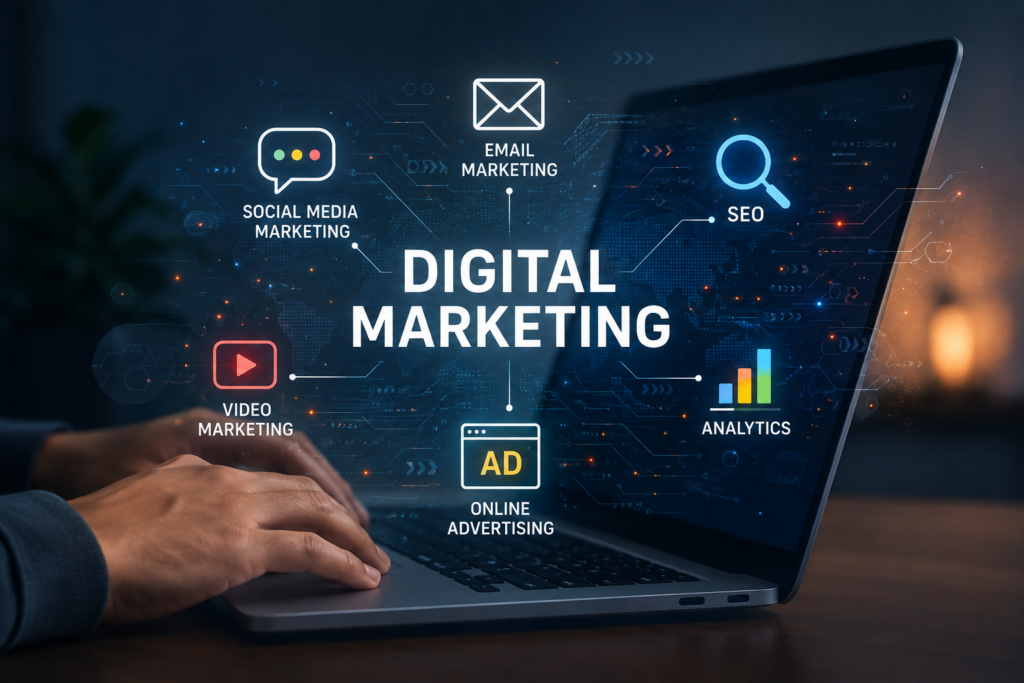
The digital world is changing faster than ever. Businesses that once depended mainly on traditional advertising are now using websites, social media, search engines, email, video, artificial intelligence, and online communities to reach their audiences. This transformation has made digital marketing one of the most important parts of modern business.
Whether it is a small local business, a growing startup, a personal brand, or a large global company, having a strong digital presence can make a significant difference. But digital marketing is not simply about posting content on social media or running advertisements. It is a complete process of understanding people, creating value, building trust, and turning online attention into meaningful business results.
What Is Digital Marketing?
Digital marketing refers to the use of digital channels, platforms, and technologies to promote products, services, brands, or individuals.
Unlike traditional marketing, digital marketing allows businesses to communicate with their target audience through multiple online channels and measure their performance.
Some of the most important areas of digital marketing include:
- Search Engine Optimization (SEO)
- Social Media Marketing
- Content Marketing
- Search Engine Marketing
- Email Marketing
- Influencer Marketing
- Video Marketing
- Affiliate Marketing
- Online Advertising
- Personal Branding
- Analytics and Performance Marketing
Each of these areas has a different purpose, but when they work together, they can create a powerful marketing ecosystem.
Why Is Digital Marketing Important?
One of the biggest advantages of digital marketing is reach.
A small business is no longer limited to customers in its local area. With a website, social media presence, and the right marketing strategy, it can reach potential customers from different cities, countries, and even continents.
Digital marketing also provides something traditional marketing often struggles with: measurability.
Businesses can track website visitors, clicks, impressions, engagement, leads, conversions, customer behavior, and advertising performance.
This data helps marketers understand what is working and what needs improvement.
Instead of spending money without knowing the exact result, businesses can analyze performance and continuously optimize their strategies.
Search Engine Optimization: Getting Discovered
Search Engine Optimization, commonly known as SEO, is one of the most valuable long-term digital marketing strategies.
SEO focuses on improving a website’s visibility in search engine results.
Imagine someone searches online for:
“Best digital marketing services near me.”
If your website appears among the top results, there is a higher chance that the person will visit your website and potentially become a customer.
SEO involves many factors, including:
- Keyword research
- High-quality content
- Website structure
- Page speed
- Mobile optimization
- Technical SEO
- Internal linking
- Backlinks
- User experience
- Search intent
Good SEO is not about manipulating search engines. It is about creating useful, relevant, and trustworthy experiences for users.
Social Media Marketing
Social media has become one of the most influential digital marketing channels.
Platforms such as Instagram, Facebook, YouTube, LinkedIn, and other social networks allow brands to communicate directly with their audiences.
But successful social media marketing requires more than simply posting promotional content.
People generally do not open social media because they want to see advertisements. They want entertainment, information, inspiration, communication, or something interesting.
Therefore, brands need to create content that provides value.
For example, a digital marketing professional could share:
- Marketing tips
- Case studies
- Industry updates
- Educational videos
- Marketing mistakes to avoid
- Behind-the-scenes content
- Personal experiences
- Success stories
Over time, useful content can help transform followers into a community.
Content Marketing: Creating Value Before Asking for a Sale
Content marketing is another major component of digital marketing.
The basic idea is simple: create useful content that attracts and educates your target audience.
Content can take many forms:
- Blog articles
- Videos
- Infographics
- Podcasts
- Social media posts
- Case studies
- E-books
- Tutorials
- Newsletters
For example, a company selling website development services could publish an article explaining how businesses can improve their website speed.
The reader may not immediately purchase a service. However, the content creates awareness and demonstrates expertise.
When that person eventually needs website development, the company may already be one of the first brands they remember.
That is the power of content marketing.
Paid Advertising and Performance Marketing
Organic marketing can take time. Paid advertising allows businesses to reach targeted audiences more quickly.
Platforms such as search engines and social media networks provide advertising systems that allow marketers to target people based on different characteristics and behaviors.
A campaign can be optimized around different objectives, such as:
- Website traffic
- Leads
- Sales
- App installations
- Brand awareness
- Engagement
However, simply spending money on advertisements does not guarantee success.
A successful campaign requires:
The right audience + the right message + the right creative + the right offer + continuous optimization.
Performance marketing focuses heavily on measurable results.
Instead of asking only, “How many people saw the advertisement?” marketers can ask more meaningful questions such as:
“How many people clicked?”
“How many became leads?”
“How many purchased?”
“What was the cost per lead?”
“What was the return on advertising spend?”
These measurements help businesses make better decisions.
The Growing Role of Artificial Intelligence
Artificial intelligence is becoming an increasingly important part of digital marketing.
AI tools can help marketers with tasks such as:
- Content ideation
- Data analysis
- Audience research
- Copywriting assistance
- Image generation
- Video creation
- Customer support
- Personalization
- Marketing automation
However, AI should be treated as a tool rather than a complete replacement for human creativity and strategic thinking.
The best results often come from combining AI’s speed and analytical capabilities with human understanding, creativity, storytelling, and judgment.
Marketers who learn how to use AI effectively can potentially save time and focus more on strategy.
Personalization Is Becoming More Important
Modern customers expect relevant experiences.
People do not want to receive the same generic message regardless of who they are.
Digital marketing allows businesses to personalize communication based on customer interests, behavior, previous interactions, and preferences.
For example, an online store can recommend products based on what a customer previously viewed.
An email campaign can send different messages to different customer segments.
A website can provide content based on the visitor’s interests.
Personalization can make marketing more relevant and meaningful.
Video Marketing and Short-Form Content
Video continues to be one of the strongest forms of digital content.
Short-form videos have made it possible for individuals and businesses to communicate ideas quickly.
A short video can educate, entertain, demonstrate a product, tell a story, or introduce a brand.
However, creating successful videos is not only about having good visuals.
The first few seconds are extremely important.
A strong hook can encourage viewers to continue watching.
For example:
“Three digital marketing mistakes that are costing businesses customers.”
This creates curiosity and gives the viewer a reason to continue.
Data and Analytics
One of the biggest advantages of digital marketing is access to data.
Analytics can help marketers understand:
- Where visitors come from
- Which pages they visit
- How long they stay
- Which content performs best
- Which campaigns generate leads
- Which audiences convert
- Where customers leave the sales journey
Without analyzing data, marketers are often making decisions based on assumptions.
With data, they can test strategies, identify problems, and make improvements.
This creates a cycle:
Create → Measure → Analyze → Optimize → Repeat.
That process is at the heart of successful digital marketing.
Building a Strong Digital Marketing Strategy
A successful digital marketing strategy should begin with clear objectives.
Before creating content or launching advertisements, businesses should understand:
Who is the target audience?
What problem are they trying to solve?
What makes the brand different?
What action should the audience take?
How will success be measured?
Once these questions are answered, marketers can select the right channels and develop a strategy.
Not every business needs to be active on every platform.
The best strategy is to focus on the platforms where the target audience is most active and where the business can consistently create value.
The Importance of Personal Branding
Digital marketing is not only useful for companies.
Individuals can also use digital marketing to build powerful personal brands.
Freelancers, designers, developers, marketers, photographers, consultants, and content creators can showcase their skills through websites and social media.
A personal portfolio website can become the center of this digital identity.
It can include:
- About section
- Skills
- Services
- Portfolio
- Projects
- Client testimonials
- Blog
- Contact information
By consistently sharing knowledge and showcasing work, professionals can build credibility and attract new opportunities.
The Future of Digital Marketing
The future of digital marketing will likely become more personalized, automated, data-driven, and AI-assisted.
But despite technological changes, one fundamental principle will remain the same:
People connect with value.
Technology can help marketers reach millions of people, but technology alone cannot create genuine trust.
Successful brands will continue to focus on understanding their customers, solving real problems, creating useful experiences, and communicating authentic stories.
The marketers who succeed will not necessarily be the people who use the most tools.
They will be the people who understand how to use the right tools for the right audience at the right time.
Final Thoughts
Digital marketing is no longer an optional strategy for businesses that want to grow online. It has become an essential part of modern communication and business development.
From SEO and social media to content marketing, paid advertising, AI, analytics, and personal branding, digital marketing provides countless opportunities to connect with people and build long-term relationships.
However, success does not come from following every trend.
It comes from understanding your audience, creating genuine value, measuring your results, learning from your mistakes, and continuously improving.
The digital landscape will continue to change. New platforms will appear, technologies will evolve, and customer behavior will shift.
But the fundamentals will remain powerful:
Understand your audience. Create valuable content. Build trust. Measure performance. Adapt continuously.
Digital marketing is not just about getting attention.
It is about turning attention into trust, trust into relationships, and relationships into long-term growth.
Great